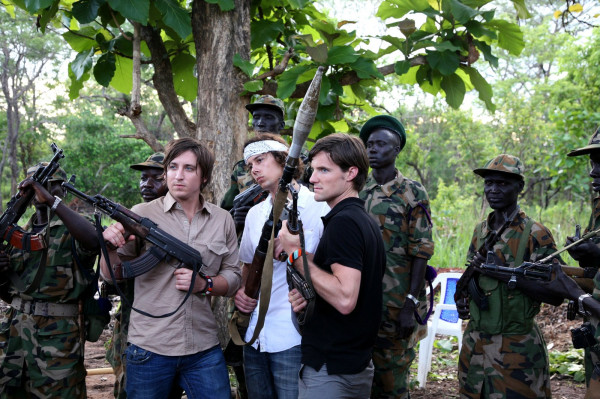
The business of child soldiers in Uganda is very murky. Museveni’s NRA rebel group had many child soldiers (called kadogos) in its ranks, and when it became the national army, it continued the practice of using children in the war in the north. But most of the children were forcefully recruited into the LRA. In all, anything between 100,000 to 150,000 had been conscripted by the time Kony was finally pushed out of Uganda.

nakedchiefs's avatarNAKED CHIEFS

Joseph Kony, a former altar boy subscribing to the same mchuzi mix of traditional-ne-fundamentalist Catholicism as Lakwena, and who also dabbled in the occult, had been lurking in the shadows in the last days of the Holy Spirit movement, recruiting former soldiers to his cause”

 This is the third part of the well-known and little-known bits of the story of the macabre insurgency by Uganda rebel leader Joseph Kony, and the often equally brutal response by the Uganda government over 20 years, as a way of providing context to judge “KONY 2012”, the video by the US group Invisible Children that passed 100 million last evening, to become the most successful viral video of all time.

The North-South divide in Uganda (common in other countries too) provides only a small explanation of the raw political passions that led to war in northern Uganda, and the rise…

View original post 1,327 more words

“Although Africa has long been known to be rich in oil, extracting it hadn’t seemed worth the effort and risk until recently. But with the price of Middle Eastern crude skyrocketing, and advancing technology making reserves easier to tap, the region has become the scene of a competition between major powers that recalls the 19th-century scramble for colonization. Already, the United States imports more of its oil from Africa than from Saudi Arabia, and China, too, looks to the continent for its energy security.”

Can the United States restrain Chinese influence on the resource rich continent? 

GB Times – The Third Angle

There’s another side to this story.

Coming soon!

Mark Kersten's avatarJustice in Conflict

The makers of Kony 2012

As we speak, one of the most pervasive and successful human rights based viral campaigns in recent memory is underway. Invisible Children’s ‘Kony 2012‘ campaign has taken Twitter, Youtube, Facebook and every other mainstream social media refuge by storm. In many ways, it is quite impressive. But there’s one glaring problem: the campaign reflects neither the realities of northern Ugandan nor the attitudes of its people. In this context, this post examines the explicit and implicit claims made by the ‘Kony 2012’ campaign and tests them against the empirical record on the ground.

Before jumping into the fray, however, I should preface the post by noting that, in many ways, Invisible Children have done a fantastic job in advocating for the rights of northern Ugandans, highlighting the conflict and providing tangible benefits to victims and survivors of LRA brutality. Indeed, this post is not intended to take aim…

View original post 1,554 more words

‘So, why won’t a U.S. President call the very well-documented forced removal of 1.5 million people from their homes — many who were forced to march more than 50 miles into the desert where almost certain death awaited them — genocide?’

mediachecker's avatarmediachecker


Apr. 25, 2013 9:28am Mike Opelka

What do you call the 1915 “mass deportation” of Armenians from the Ottoman Empire (Turkey) that resulted in the death of 1.5 million people?

Most historians and Armenians around the world call it genocide. The Turkish government and the United States are not among those who will officially accept the word “genocide” when speaking of the decimation of the Armenian people in the early part of the 20th Century. (And that list also includes U.S. Presidents.)

The Armenian Genocide   Why Wont American Presidents Mention

The lack of respect given to the Armenian genocide is shocking when you consider the scope and brutality of the event that killed 75 percent of the Armenians — a predominantly Christian group.

The History:

Armenia was a trendsetter when it came to Christianity. The country adopted that faith in 301 A.D. This was even before the formation of the Holy Roman Empire. For centuries the Armenian people…

View original post 10,769 more words

And interesting viewpoint regarding the hunt for Joseph Kony and US military intervention in Uganda / East Africa…

stopwarcrimes's avatarStop War Crimes!

By Junious Ricardo Stanton, 22 October 2011, Source: theblacklistpub.ning.com

A determined push by Western wildcatters and big oil companies from fast-growing Asian economies such as those of China and Malaysia may change the fortunes of several countries in remoter and trickier bits of Africa once largely ignored by foreign investors. One of the most spectacular recent finds has been in Uganda. The reserves of the Albertine rift, which takes in the Ugandan and Congolese shores of Lake Albert (see map), are said to need $10 billion for development. All being well, Uganda will soon become a mid-sized producer, alongside countries such as Mexico. Foreign investment in Uganda may nearly double this year to $3 billion. The country expects to earn $2 billion a year from oil by 2015.” [The Economist]

On Friday October 14th President Obama sent a letter to Congress informing them he was…

View original post 1,359 more words

PaanLuel Wël Media Ltd.'s avatarPaanLuel Wël Media Ltd - South Sudan

Published on 26/08/2011Remember when they say “A picture is worth a thousand words?” This is it!!

cartoon260811_01.jpg

http://www.standardmedia.co.ke/cartoon/

View original post

Bikes 4 Life in Uganda.

‘I dreamed a Dream’ Performed live by Patrick Roberts at Bikes 4 Life’s Annual Fundraiser in Melbourne.See bikes4life.com.au for more info on the great work by Bikes 4 Life.

I Dreamed a Dream – Uganda from Ebony Butler on Vimeo.

Follow Bikes 4 Life at www.facebook.com/bikes4lifeorg

Congo Resource Wars: Everyone has a finger in the pie…

Andrew Gavin Marshall's avatarAndrew Gavin Marshall

Congo Resource Wars
Global Research, March 12, 2008
geopoliticalmonitor.com – 2008-03-01
This report examines the current war and genocide in the Democratic Republic of Congo, which started in the mid-1990s, placing emphasis on the roles of Western covert operations, corporations and the plundering of resources that has resulted.

War in the CongoKing Leopold’s War for Rubber

Nearly 125 years ago, during the beginning of the European ‘Scramble for Africa’, European empires competed with each other to take over Africa and plunder it for its resources. The King of Belgium at the time, King Leopold II, sought to take control over the Congo, as during the time, “the demand for rubber increased dramatically,” and the “Congo contained wild rubber trees which could be harvested immediately to meet the spiraling demand.”[1] This was achieved by forcing African males to work by taking “their families hostage until a certain amount of rubber…

View original post 1,372 more words

Check out this clip –  a sneak peek into our documentary, currently titled ‘Mad Vs Bad’.

We are in post-production, about to start editing with renowned Australian editor Bill Murphy.

Let us know your thoughts and please follow our progress on Facebook, Twitter and YouTube!

Well the past few months have been very interesting. We are excited to announce that we have a new producer on board, Jason Byrne!

Also, we have just returned from yet another filming trip, this time it was back in the UK! It was quite last minute, I was in Sydney packing a container of bikes just 10 days ago for an upcoming shipment to Cambodia for my charity Bikes 4 Life, and that’s when I got the call!

I was offered an opportunity to conduct some exclusive interviews with some people who are extremely difficult to access, but those who could add enormous insight into the film. There was also an ‘invitation only’  press conference that I was invited to attend. How could I refuse?

So, I had about 4 days to get everything sorted, get a camera man, get flights, and get all the way from Melbourne to London! As it turned out, I did go, and it all worked out rather well! My new producer organised a great camera man / DP, Ellery Ryan, who was simply brilliant!

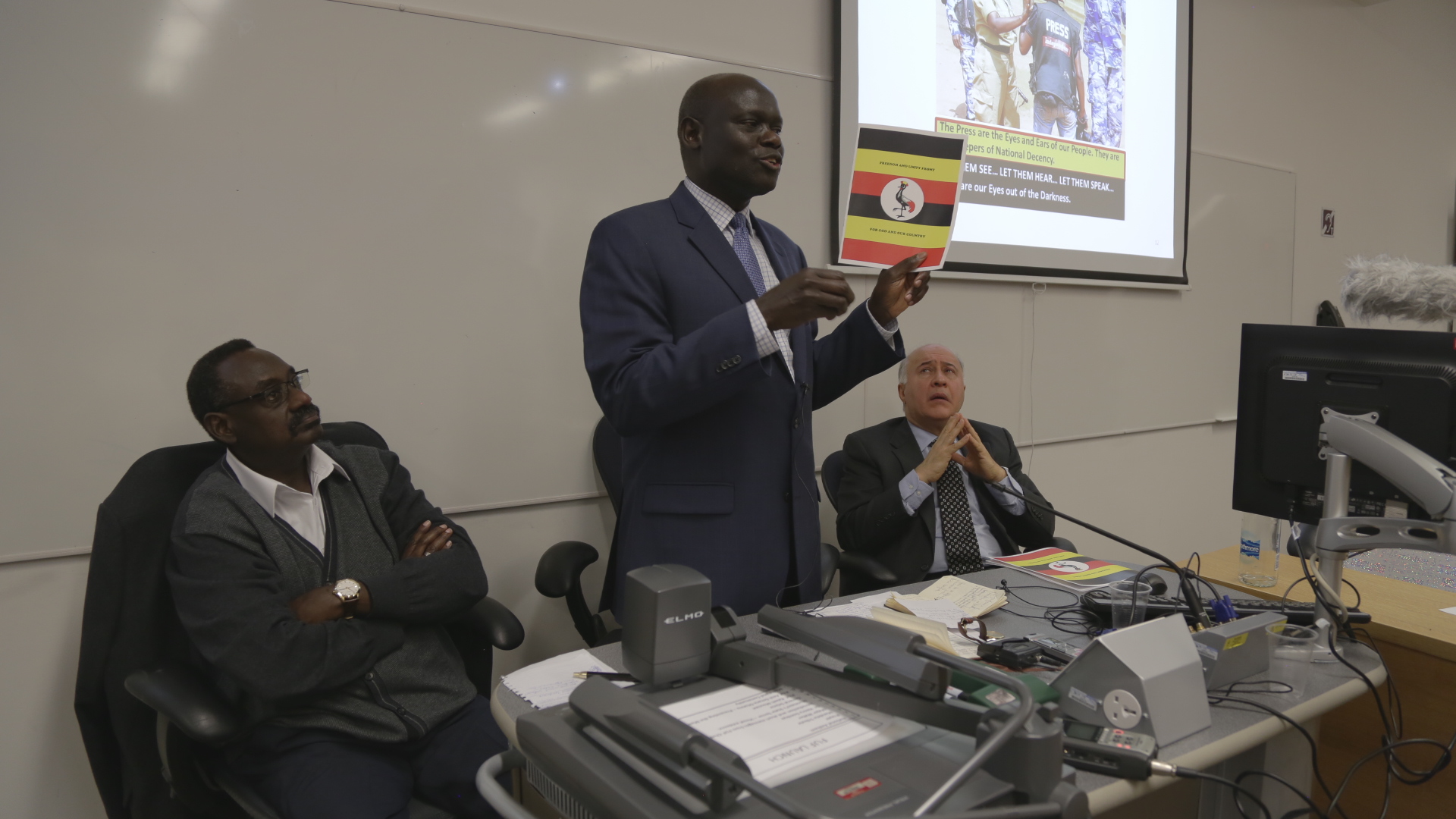
I won’t mention all the interviews I conducted, but I will touch on the event that I was invited to attend and document. It was the press conference and launch of the recently formed Ugandan Party, FUF (Freedom and Unity Front) and its Manifesto.

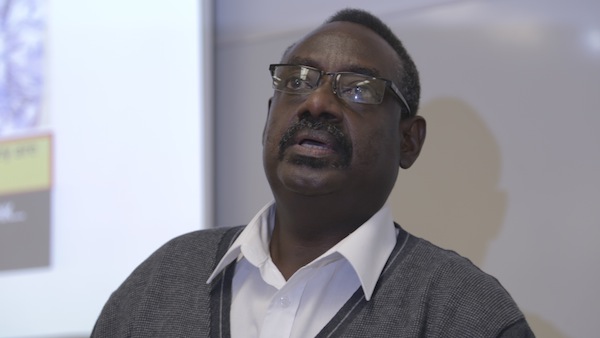
The function was held at the London School of Economics (LSE) Alumni Theatre Hall on Saturday. Speakers included Professor Kaveh Moussavi of Oxford University, Dr. Amii Omara Otunnu (FUF Chairman) and Genral David Sejusa (formerly known as Tinyefuza).

General David Sejusa (Tinyefuza)
Renegade General David Sejusa (Tinyefuza)

General Sejusa, fled Uganda in April after authoring a controversial letter to internal security bosses to investigate reports of planned assassinations of members opposed to the alleged grooming of the President’s son, Muhoozi, for presidency. Sejusa fought in the National Resistance Army war that brought President Museveni to power in 1986. He also led military operations in northern Uganda against brutal warlord Joseph Kony. Sejusa was accused of highhandedness and committing atrocities in the bloody war. After an on-and-off relationship with Museveni, Sejusa in April decided to break ranks with government before escaping to London, UK where he has helped form FUF, with aim to cause regime change in Uganda. (http://chimpreports.com)

At the launch General David Sejusa, formerly the most senior army officer and closest ally of Ugandan President Yoweri Museveni, lifted the lid on what has been going on in the country during the 27 years of Museveni’s rule. It included heavily the state of corruption, and explicitly detailed the election rigging of the 2006 elections, stating that opposition leader Kizza Besigye clearly one the election in a landslide victory.

FUF Launch in London: General David Sejusa, Dr. Amii Omara-Otunnu and Professor Mouvani
FUF Launch in London: General David Sejusa, Dr. Amii Omara-Otunnu and Professor Kaveh Moussavi

FUF claims it intends to front “the global campaign to transform Uganda into a nation of peace and sustainable development based on the ethical values of democracy, respect for human rights, and the rule of law.”

The day before leaving I also had the chance to meet again with Milton Allimadi, who had flown in from New York for the event. Milton is the publisher of Black Star News, and I had the privilege of interviewing him back in New York in 2011.

Ebony and Milton Allimadi of Black Star News

I also was honoured to meet with the brother of Dr. Olara Otunnu (UPC President) and human rights expert, Dr. Amii Omara-Otunnu, who I also conducted an interview with. He is the interim Chairman of FUF.

Dr. Amii Omara-Otunnu is the UNESCO Chair in Comparative Human Rights and Professor of History at the University of Connecticut. In addition to his UNESCO chairmanship, he is also the Executive Director of the Institute of Comparative Human Rights at the University of Connecticut.

I will release some footage from the interviews and press conference soon so please check back!

Uganda is going through some very interesting times. Times of change.

I’m back in Australia now, and have to get everything together, as a new and final stage of post-production is to begin in early 2014.