Check out this clip –  a sneak peek into our documentary, currently titled ‘Mad Vs Bad’.

We are in post-production, about to start editing with renowned Australian editor Bill Murphy.

Let us know your thoughts and please follow our progress on Facebook, Twitter and YouTube!

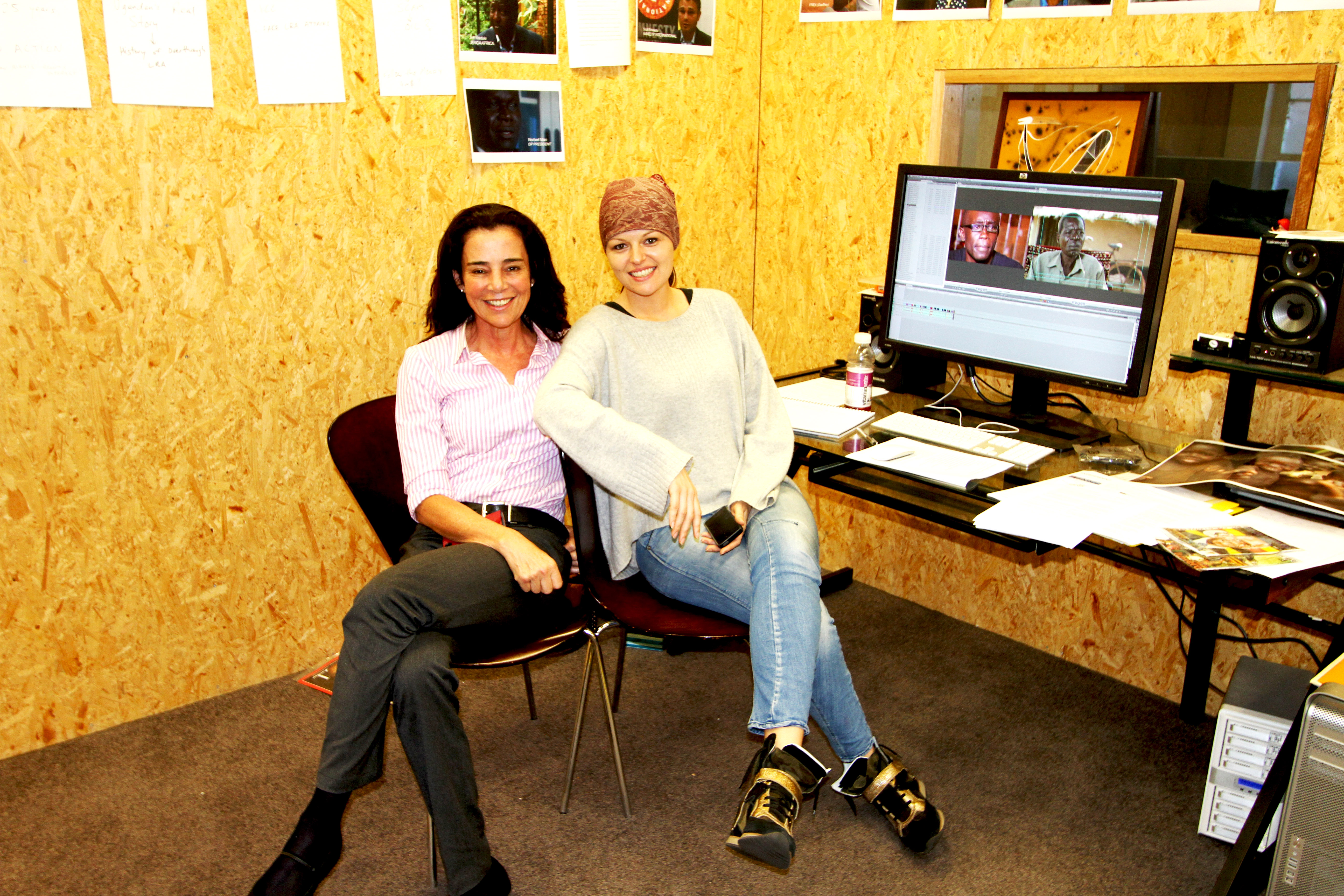
We have recently moved into new studio in Melbourne, as we enter the final stages of post-production.


We have partnered with filmmaker Bernie Ryan from Cyber City Films, and are working hard to complete our first edit for the documentary.


We haven’t yet updated anyone on our recent trip to Uganda, and will do that soon! It was an eventful trip and we accessed some people who we thought would have been impossible.


Victims of all sorts of atrocities, with an important story to tell.


eb and penny studio


Yesterday Human Rights Watch (HRW) released a new 50 page report on Uganda documenting an influx of government attacks on organizations whose focus includes oil revenue transparency, land acquisition compensation, legal & governance reform, and protection of human rights.

Excerpt: ‘If your research raises a flag about people in power in this country, and how they are getting money out of this country, you are at serious risk. If you preach human rights, you are anti-development, an economic saboteur. You are not going to talk about land, oil, and good governance.’

Comment from our Child Troopers Facebook Post:

Doka Oringtho Musa: When Museveni wants to use the Army to steal elections, he does not need the Civil Society monitoring his activities.

Uphold Rights of Freedom of Expression and Association

AUGUST 21, 2012
  • © 2011 Human Rights Watch
Uganda’s government is putting serious pressure on civil society, particularly on organizations that might be seen as infringing upon the officials’ political and financial interests. Civil society should have space to conduct research and take part in policy debates without fear of government reprisals.
Maria Burnett, senior Africa researcher at Human Rights Watch

(Nairobi) – Research and advocacy organizations inUganda that deal with controversial topics are facing increasing harassment by Uganda’s government, Human Rights Watch said in a report released today. Groups have recently faced forced closure of meetings, threats, harassment, arrest, and punitive bureaucratic interference. The Ugandan government should end its hostile rhetoric and repeated obstructions of nongovernmental organizations, Human Rights Watch said.

The 50-page report, “Curtailing Criticism: Intimidation and Obstruction of Civil Society in Uganda,”documents increasing government attacks on organizations whose focus includes oil revenue transparency, land acquisition compensation, legal and governance reform, and protection of human rights, particularly the rights of lesbian, gay, bisexual, and transgender (LGBT) people. Both government ministers and district-level officials have engaged in obstruction, Human Rights Watch said.

“Uganda’s government is putting serious pressure on civil society, particularly on organizations that might be seen as infringing upon the officials’ political and financial interests,” said Maria Burnett, senior Africa researcher at Human Rights Watch. “Civil society should have space to conduct research and take part in policy debates without fear of government reprisals.”

President Yoweri Museveni, in office since 1986, is widely believed to be gearing up for yet another term. Since his re-election in 2011, political tensions have been running high and public criticism of government has escalated. To better control this environment the ruling party’s high-ranking government officials are increasingly scrutinizing nongovernmental organizations and the impact they might have on public perceptions of governance and management of public funds, Human Rights Watch found.

This report is based on research carried out by Human Rights Watch staff throughout 2011, as well as in-country research from May to July 2012, and a review of Uganda’s nongovernmental regulations and other relevant laws. Human Rights Watch interviewed 41 people, including 25 representatives of organizations working on a broad range of thematic work and from around the country, as well as donors, police, and government actors.

The operations of nongovernmental organizations in Uganda are regulated by the country’s NGO Act, which requires organizations to register with the government’s NGO Board, managed by the minister of internal affairs. Members of Uganda’s intelligence services sit on the board to monitor civil society activity. In this way, organizations are treated as possible national security threats.

The NGO Act as amended in 2006 restricts operations of nongovernmental organizations through lengthy and convoluted registration requirements and confusing procedures that groups are expected to comply with in order to receive permission to conduct research. In April 2009 eight organizations filed a challenge to the act before the Constitutional court, arguing that some provisions are inconsistent with the constitution, the International Covenant on Civil and Political Rights, and the East African Community Treaty. The case is yet to be scheduled for a hearing.

A large number – perhaps thousands – of nongovernmental organizations operate in Uganda. The government allows some groups, particularly those involved in service delivery, significant latitude. But oil transparency, land, governance, and human rights groups have had an increasingly difficult time both carrying out their work and advocating for change in public forums, Human Rights Watch found.

In 2010, the Ministry of Internal Affairs and the leadership of the nongovernmental organization sector negotiated an NGO Policy, a generally positive document that is an important step in addressing civil society concerns. But the government has not formally put the policy into operation and it holds no legal weight. Recent actions of the government’s NGO Board betray the aspirations of the policy. For example, in June 2012 the board told one organization working in governance and oil revenue transparency to desist from participating in “loose unregistered coalitions.” The NGO Policy specifically states that “clusters, networks or umbrella organizations” should be strengthened. The nongovernmental organization laws are silent on how or if coalitions must register as a legal entity.

In May 2012, the government ordered the NGO Board to carry out an investigation into the research of a group that documents unlawful land acquisitions. The board, acting outside its legal mandate, recommended that the organization should apologize for a report it issued about the subject and withdraw it, or face deregistration.

Another group working to help local communities receive fair compensation for land used in a large-scale electricity project was said to be “bordering on sabotage of government programs” by the government agency involved in the project. The government requires any organization to seek written permission from the permanent secretary of the Ministry of Energy and Mineral Development each time they seek to visit the oil region, even though no law or publicly available policy requires them to seek such permission for the visits. These policies and practices obstruct access to affected communities and inhibit research and advocacy on oil accountability and transparency.

One representative of a nongovernmental group told Human Rights Watch that, “If your research raises a flag about people in power in this country, and how they are getting money out of this country, you are at serious risk. If you preach human rights, you are anti-development, an economic saboteur. You are not going to talk about land, oil, and good governance. This is just the beginning, but the tensions have been accumulating.”

At the same time, the government’s hostility to, and harassment of, Uganda’s LGBT community and its leadership is unabated. Government officials demonizing homosexuality are targeting a vulnerable community and deliberately misinforming the public, stirring hatred, and diverting donor attention. LGBT organizations are forced to operate on the margins because criminal laws on homosexuality prevent them from legally registering with the NGO Board. In the last few months two workshops focused on advocacy for the rights of LGBT people have been forcibly shut down by police at the behest of the minister of state for ethics and integrity, though there is no basis in law for such actions. In one instance activists were temporarily detained. The minister has stated unequivocally that organizations supporting the rights of LGBT people will be deregistered.

With the public’s frustrations with the ruling party leadership since the February 2011 elections, many see the government’s relentless focus on the alleged threat of homosexuality as a facile populist strategy to gain support. The LGBT community in Uganda remains deeply vulnerable to public harassment and violence. Organizations told Human Rights Watch that they fear that the hostility toward the LGBT community will be used to slander human rights organizations and undercut their work in all areas.

“It is not illegal in Uganda to discuss homosexuality or advocate for legal reform to decriminalize homosexuality, and government officials should not behave like it is,” Burnett said. “Government officials should remember they have a duty to protect the rights of all citizens, not only citizens they agree with.”

Given the increasingly challenging operating environment, staff and representatives of nongovernmental groups expressed serious concerns about their ability to maintain their research, advocate positions on controversial issues, and protect their employees. Representatives of these groups told Human Rights Watch that they fear they will not be able to carry out their mandates due to the hostile environment, and some acknowledged that they have begun to censor their own work to maintain some level of operations.

The government of Uganda should change its approach to all nongovernmental organizations, especially those working on sensitive or controversial subjects, and improve the operating space for all civil society, Human Rights Watch said. The government should rein in hostile rhetoric, amend laws that treat nongovernmental organizations as possible threats to national security, and publicly support the essential role of civil society. In turn, Uganda’s international partners, especially those considering funding the NGO Board, should actively voice their concerns about the need to end unjustifiable interference in civil society operations.

“The government should publicly support the essential role of civil society in stimulating public debate, rather than attacking this essential element of a human rights-respecting democracy,” Burnett said. “Uganda’s international partners should actively voice their concerns regarding these threats to nongovernmental groups, particularly given the escalation in government hostility toward freedom of expression and association.”
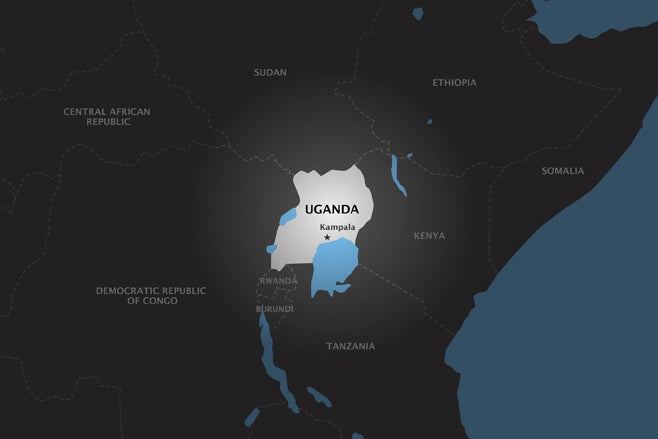
For many years, international companies have benefited from the instability in the Democratic Republic of Congo.

via Clinton, Kagame and M23.

Excerpt from Article:

No blackmail, but persistence of a long term plan’ 

For many years, international companies have benefited from the instability in the Democratic Republic of Congo. Paul Kagame and Joweri Museveni have as well continued to plunder the country’s resources through a network of armed militias spread all over Eastern Congo.

There has been an official narrative which has been successively sold to the general opinion saying that the Rwandan genocide of April 1994 was a failure of the international community to protect lives in danger.

And for that reason, there are views particularly among Western scholars and foreign aid agencies claiming that the unconditional support to Rwanda over these last 18 years was a consequence of their guilt.

Either they are in denial of what they fully know, or they want to fool those among the general public who are ignorant of what has been going on.

Child Troopers Teaser 1 from Ebony Butler on Vimeo.

This is the first cut of a teaser for my documentary film Child Troopers, about the war between Joseph Kony‘s LRA (Lord’s Resistance Army) and the Ugandan Government.

Much more to come with new footage from Uganda 2012 so stay tuned!

See: www.atlanticstarproductions.com
www.faceook.com/childtroopers

My second trip to Uganda was vastly different from the first, back in 2009.

In 2009, I was researching the LRA (Lord’s Resistance Army), Joseph Kony and the topical issue of children in armed conflict. I spent most of my time with former child soldiers in Northern Uganda and also made a promise to a group of child soldiers that I had become close to. The promise was to send 2 bicycles, to help them in their lives and in their rehabilitation and re-integration into society.

In 2012, I returned with a container of 400 bicycles, a mission I had been on since my trip there in 2009. I also set up a bike workshop and vocational training centre at Friends of Orphans in Pader, to help victims of the conflict.

As as far as my research on the war in Northern Uganda goes, I had learnt a lot more in the three years since my first visit. During that period I also traveled to the United States, where I interviewed people at the United Nations, Human Rights Watch, Amnesty International, Black Star News, UNICEF, Resolve Uganda and many other organizations.

My knowledge of the conflict grew day by day, and when I returned to Uganda earlier this year, I had many new contacts to meet and learn from. These included notable and die-hard pro-democracy activists such as Barbara Allimadi, Shawn Mubiru, Anne Mugisha, opposition leaders Kizza Besigye, Nandala Mafabi and the honorable UPC President and former UN Under Secretary General for Children in Armed Conflict, Dr. Olara Otunnu. The experts and scholars I met with included Adam Branch from Makerere University, Leander Komakech, Okello Okello John Livingstone and Major General Pecas Kutesa – who all offered interesting and informative insights into the war and the state of democracy in Uganda. This really put a new spin on my take of the conflict, which had gradually been happening since the U.S trip in 2011. There were things that didn’t add up and it has taken a long time to work out the truth, as the media portrayal of the conflict is far from the facts I had uncovered. Uganda, I also discovered, was a democracy in disguise. On two occasions I was almost arrested, for no reason other than having a camera and having friends who are with the opposition. On my last day in Uganda, the day I was grabbed by the Police and threatened to be tear gassed, my friend Doreen was actually arrested and put into maximum security prison (Luzira), for voicing her opinion about the government and Museveni’s corrupt regime. I can tell you first hand, Uganda is not as free and democratic as it appears to be…

I still spend countless hours researching the conflict and the human rights situation in the country, as what has occurred in Northern Uganda has been so well concealed by the powers that be, and the international community at large, making it very difficult for the truth to be made visually transparent. The ‘Kony War‘, as it is often called, is not what it seems. That is not to say that Kony does not exist, nor that he has not committed the atrocities that are now well-known to the world, thanks to the viral video campaign from Invisible Children, Kony 2012. The perpetrator of this conflict is not Kony, as most would believe due to media and government deception and misinformation. Joseph Kony is sadly a product of the war, and should still however be made to face justice for his crimes. But, will that bring justice to the Acholi people of Northern Uganda, particularly if the other perpetrators are not also made to stand trial for their involvement in this human tragedy? How can justice prevail when impunity reigns?

This year I also spent much time in Uganda looking into how the conflict can be resolved and what is the best way forward. Is military intervention (which is what is currently happening) the correct road, or could truth and reconciliation through national dialogue and peace talks be a better and more effective option? There are many differing views on this subject, but on the ground, there seems to be only one. Invisible Children have called out loud and clear for U.S military intervention in the region, but where has that got them in the past, and for what reasons would they really be intervening? The fact of the matter is, why intervene now, when they really needed to intervene 10 years ago, when there was a serious humanitarian crisis going on. That’s when everyone was silent on what was going on. That’s when help was needed and voices needed to be heard. Now there is relative peace and the people in Uganda want to know, “WHY NOW?”.

‘Peace cannot be kept by force; it can only be achieved by understanding.’
Albert Einstein

War on LRA Rebels Loses Momentum Report:  Institute for War and Peace Reporting

Efforts to defeat feared group run into trouble as regional governments fail to address threat.

ACR Issue 300, 17 Aug 11 – By Barrett Holmes Pitner – International JusticeICC

Amid concerns that efforts to flush out Uganda’s Lord’s Resistance Army, LRA,

are flagging, the international community is facing stark challenges to defeat the

rebels as they continue to wreak havoc in the region. Since the United States

announced a long-awaited strategy to defeat the LRA and capture its leaders by

bolstering the military effort in the region, Uganda has instead withdrawn 700

troops that were pursuing the rebels and curtailed  funding for the operation.

Child Troopers is currently in pre-production, with principal photography scheduled to begin next month in the United States of America. Director of Child Troopers, Ebony Butler, will be traveling to Los Angeles next week where she will work with Child Trooper’s U.S Producer, Alec Pedersen (The Cove; Unity). She will then head across to New York and Washington DC to conduct interviews and further research issues related to the film.

Research for the upcoming trip to America will focus on children in conflict & child soldiers, peace & justice, civilian protection & security, aid & development, modern day child slavery & child trafficking.

More information regarding Child Troopers will be released soon so keep checking in for updates!

If there is something you would like to know, or an opinion you would like to voice, please do as we encourage dialogue and promote discussion on all issues!

Please ollow us on Facebook.com/childtrooopers or check out the blog atlanticstarproductions.blogspot.com for information on human trafficking, slavery, human rights, child soldiers and much more!

PEACE, LOVE AND GRATITUDE TO ALL! 

(more…)

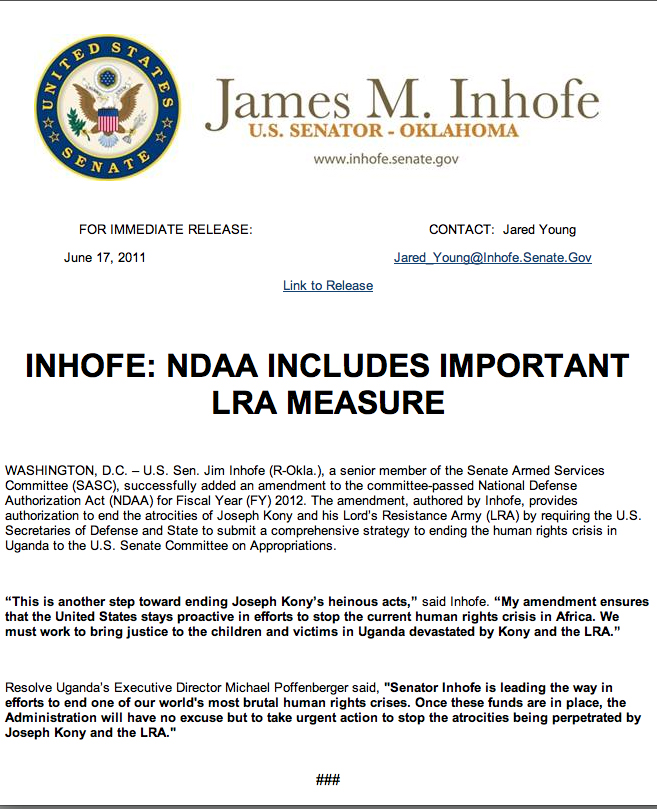
James Inhofe - LRA Bill of 2010
James Inhofe Amends NDAA Act


Does Senator Inhofe’s amendment of the US National Defense Authorization Act, directed towards ending the LRA conflict, have any real power? Is it implying the government use direct military action to reach its goals? What efforts are in place from December;’s comprehensive strategy released by President Obama? The LRA are still operating freely, and this year attacks have increased across east and central Africa. I just hope the US are actually being active in their attempt to resolve the issue and bring Kony and those responsible to justice, otherwise there would be no cause to be pro-active.

Justice won’t be served when and if Kony is caught. That would be just one small step toward justice. And will Joseph Kony‘s elimination from the equation even stop the atrocities from the LRA’s brutal insurgency? In the meantime however, it could be an idea to focus on healing the current victim’s of this war, as there is no uncertainty there – they clearly exist and are still suffering, awaiting help from the outside world. The LRA bill has been successful at harnessing popularity, however, what ever happened to the Northern Ugandan Recovery Act? It’s not as catchy I guess.